

Cricket is a game filled with statistics, strategy, and passion. One of the most important statistics that fans, players, and analysts discuss is the strike rate. In this article, I’ll provide a detailed explanation of what the strike rate in cricket means, how it’s calculated, and why it matters. Whether you’re a budding cricketer, a passionate fan, or someone simply curious about the sport, understanding the strike rate will enhance your appreciation of the game.
The strike rate in cricket is more than just a number; it reflects a player's ability to score runs quickly and can significantly influence the outcome of a match. As I delve into this topic, you’ll discover how the strike rate can be a game-changer and why it should be a key focus for players and coaches alike. So, let’s get started!

Source: www.youtube.com
What is Strike Rate in Cricket?
The strike rate in cricket is a measurement that indicates how quickly a player scores runs. It is calculated using the formula:
[\text{Strike Rate} = \left( \frac{\text{Total Runs Scored}}{\text{Total Balls Faced}} \right) \times 100
]
This formula gives a percentage that represents the number of runs scored per 100 balls faced. For instance, if a batsman scores 50 runs off 30 balls, their strike rate would be:
[\text{Strike Rate} = \left( \frac{50}{30} \right) \times 100 = 166.67
]
A higher strike rate indicates a more aggressive batsman who can score runs quickly, while a lower strike rate suggests a more cautious approach.
Source: www.quora.com
Why is Strike Rate Important?
Understanding the significance of strike rate is crucial for several reasons:
1. Impact on Match Outcomes
A high strike rate can turn the tide in a match, especially in limited-overs formats like One Day Internationals (ODIs) and Twenty20 (T20) cricket. Teams often need to chase down targets quickly, and players with high strike rates can contribute significantly to achieving those targets.
2. Player Evaluation
Coaches and selectors often use strike rates as a metric to assess a player’s performance. A consistent high strike rate can lead to selection for national teams and franchise leagues, while a low strike rate might raise concerns about a player's ability to contribute effectively.
3. Strategy and Game Plans
Understanding strike rates helps teams devise strategies. For example, a team may choose to send in a batsman with a high strike rate during the final overs of an innings to maximize scoring potential.

Source: www.youtube.com
How to Calculate Strike Rate
Calculating strike rate is straightforward, but it’s important to understand the context in which it’s used. Here’s how to do it step by step:
Step 1: Gather Data
Collect the total runs scored and the total balls faced by the batsman during a specific innings.
Step 2: Apply the Formula
Use the formula mentioned earlier to calculate the strike rate.
Step 3: Interpret the Result
Analyze the strike rate in relation to the match situation. For example, a strike rate of 120 may be excellent in a T20 match but might be considered low in a chase during an ODI.
Example
Let’s say a player scores 75 runs off 50 balls in a T20 match. The strike rate would be:
[\text{Strike Rate} = \left( \frac{75}{50} \right) \times 100 = 150
]
This indicates that the player scored 150 runs for every 100 balls faced, showcasing a solid performance.

Source: blog.decathlon.in
Strike Rate Across Formats
The importance of strike rate varies across different formats of cricket. Here’s a breakdown of how strike rates are perceived in Test matches, ODIs, and T20s:
Test Matches
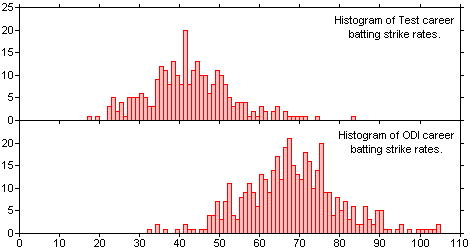
In Test cricket, the focus is often on building an innings and playing long, patient knocks. Therefore, a strike rate around 50-60 is generally acceptable. Batsmen like Steve Waugh and Rahul Dravid, known for their technique and temperament, often had strike rates in this range.
One Day Internationals (ODIs)
In ODIs, the need for a higher strike rate becomes more pronounced. A strike rate of 80-100 is considered good, while top players often exceed 100. For example, players like AB de Villiers and Virat Kohli have consistently maintained strike rates above 90.
T20 Matches
In T20 cricket, the strike rate is crucial. Players are expected to score quickly, with strike rates often exceeding 130 or 140. Batsmen like Chris Gayle and Jos Buttler are known for their explosive batting and high strike rates.

Source: www.youtube.com
Factors Influencing Strike Rate
Several factors can influence a player's strike rate, including:
1. Pitch Conditions
The nature of the pitch can significantly affect scoring rates. A flat pitch with good batting conditions may lead to higher strike rates, while a bowler-friendly pitch may result in lower strike rates.
2. Bowling Attack
The quality of the bowling attack also plays a role. Facing world-class bowlers may require a more cautious approach, leading to a lower strike rate.
3. Match Situation
The context of the match—such as the target to chase or the stage of the innings—can dictate how aggressively a player bats. Players may accelerate their scoring in the final overs, impacting their overall strike rate.
4. Batting Position
A player's batting position can influence their strike rate. Openers often have the freedom to play aggressively, while middle-order batsmen may need to stabilize the innings first.
Source: en.wikipedia.org
Common Misconceptions About Strike Rate
There are several misconceptions surrounding strike rates that I’d like to address:
1. High Strike Rate Equals Better Player
While a high strike rate is impressive, it doesn’t always indicate a better player. A batsman’s ability to adapt their game to different situations is equally important.
2. Strike Rate is the Only Metric to Consider
Strike rate is a crucial statistic, but it should be considered alongside other metrics such as average, consistency, and match-winning ability.
3. All Formats Require High Strike Rates
Different formats have different demands. While T20s prioritize high strike rates, Test cricket values patience and technique.

Source: www.youtube.com
How to Improve Your Strike Rate
If you’re a player looking to enhance your strike rate, here are some actionable tips:
1. Focus on Timing
Work on your timing and placement. Good timing can help you find gaps and score runs without taking unnecessary risks.
2. Practice Hitting Boundaries
Incorporate boundary-hitting drills into your practice sessions. The more comfortable you are with hitting boundaries, the higher your strike rate will be.
3. Assess Match Situations
Learn to read the game and adapt your approach according to match situations. Being aware of the required run rate can help you decide when to accelerate.
4. Improve Fitness Levels
Being fit allows you to run quicker between the wickets, which can significantly contribute to your overall scoring rate.
5. Analyze Your Game
Review your performances regularly. Analyze your strike rate in different match situations and identify areas for improvement.
Source: www.quora.com
Famous Players with High Strike Rates
Several players have made a name for themselves with their exceptional strike rates. Here are a few notable examples:
1. AB de Villiers
AB de Villiers, known as "Mr. 360," has one of the highest strike rates in international cricket. His ability to score quickly from all areas of the ground has made him a legend in the game.
2. Chris Gayle
Chris Gayle is synonymous with explosive batting. His strike rate in T20 cricket is often above 150, making him one of the most feared batsmen in the format.
3. Virat Kohli
Virat Kohli is not only known for his consistency but also for his ability to score quickly. His strike rate in ODIs often exceeds 90, demonstrating his aggressive style of play.

Source: www.cricketnmore.com
Frequently Asked Questions About Strike Rate in Cricket
1. What is a good strike rate in T20 cricket?
A good strike rate in T20 cricket typically ranges from 130 to 150. Top players often exceed these numbers, showcasing their ability to score quickly.
2. How does strike rate affect the outcome of a match?
A higher strike rate can help a team chase down targets more effectively, especially in limited-overs formats. It allows teams to score runs quickly, putting pressure on the opposition.
3. Can a player with a low strike rate still be effective?
Yes, a player with a low strike rate can still be effective, especially in Test cricket where building an innings is crucial. Their ability to anchor the innings can be just as valuable.
4. How do you calculate strike rate?
Strike rate is calculated using the formula: (Total Runs Scored / Total Balls Faced) x 100. This gives you a percentage that reflects the player's scoring ability.
5. Does strike rate vary between different formats?
Yes, strike rates vary significantly between formats. T20 cricket demands higher strike rates compared to Test matches, where patience and technique are more important.

Source: www.youtube.com
Conclusion
Understanding the strike rate in cricket is essential for appreciating the game's nuances. It’s not just a number; it’s a reflection of a player's ability to impact the game. Whether you’re a player aiming to improve your game or a fan looking to deepen your understanding, keeping an eye on strike rates can enhance your cricket experience.
As you continue to explore the world of cricket, remember the importance of adaptability and strategy. I encourage you to watch matches with a fresh perspective, focusing on how players manage their strike rates in different situations. If you have any questions or want to share your thoughts, feel free to leave a comment below!

Mayank Chaudhary is a former Indian domestic cricketer, now working as a cricket analyst. With years of on-field experience and deep insight into the dynamics of the game and the world of cricket betting, he now shares his expertise to help fellow cricket enthusiasts make smarter, more informed bets. Learn more on the About Me page.